
Security Camera Footage Retention Needs: How Long Should Businesses Keep Footage?
One of the most common questions we get asked at SCW is how long businesses should keep security camera footage. The truth is, there’s no universal retention period that works for every business or camera.
The right answer depends on your industry, why you're recording, how long incidents take to discover, and whether footage may be needed for regulatory inspections, insurance claims, quality investigations, or legal proceedings.
For many businesses, 30 days is a reasonable starting point. Others may need 90 days, a year, or even five to six years in highly regulated industries like pharmaceutical manufacturing.
At SCW, we help businesses establish practical retention strategies and design reliable, long-term video storage systems. This page explains the key requirements, industry-specific retention periods, and how to build a system that meets your needs.
Is There a Law That Says How Long Businesses Must Keep Security Footage?
For most U.S. businesses, no single federal law specifies how long security camera footage must be retained. However, industry-specific regulations, contractual obligations, data protection laws, and recordkeeping requirements can change that answer considerably, particularly when footage is needed for legal or investigative purposes.
Even the National Institute of Standards and Technology (NIST) leaves room for organizations to establish their own retention policies. Under NIST SP 800-53, PE-6(3), organizations are directed to retain video recordings for an "organization-defined time period."
This means businesses need to determine an appropriate retention period based on their security risks, operational requirements, and applicable obligations. They should also consider practical factors such as video format, recording quality, and whether longer retention periods require more storage space to keep footage accessible when needed.
When security camera retention is legally mandated
Some industries have specific surveillance retention requirements.
For example, under California Code of Regulations, Title 4, Section 15044, licensed cannabis businesses must maintain surveillance recordings for at least 90 calendar days. Their systems must also record continuously at a minimum resolution of 1280 × 720 pixels and 15 frames per second.
These requirements apply specifically to California cannabis licensees, not all businesses operating in the state.
If you're a cannabis business that may be subject to these rules, you can learn more in SCW's California cannabis surveillance guide.
Industry certifications and contractual requirements
Legal mandates aren't the only source of retention requirements.
The Transported Asset Protection Association (TAPA) Facility Security Requirements (FSR) specify a minimum of 30 days of CCTV storage, where permitted by local law. This minimum appears in both the 2023 FSR standard and the 2026 FSR requirements.
TAPA is a security certification framework rather than a federal law. However, meeting its requirements may be necessary to maintain certification or satisfy customer contracts.
Does PCI compliance require 90 days of security footage?
Not necessarily.
Accepting credit cards doesn't automatically mean your business must retain all CCTV footage for 90 days under PCI DSS.
However, PCI DSS Requirement 9.2.1.1 requires physical-access monitoring data for sensitive areas within the cardholder data environment (CDE) to be retained for at least three months, unless otherwise restricted by law.
This applies to areas such as data centers, server rooms, and back-office spaces housing systems that store, process, or transmit cardholder data, or systems critical to securing that environment. It generally doesn't include public-facing retail areas where only point-of-sale terminals are present.
Businesses can use security cameras, physical access control systems, or both to monitor entry and exit points. Where video is used, the relevant recordings must be retained for at least three months.
Read our article on PCI compliance to learn when the 90-day retention requirement applies to your business.
When video becomes a regulated record
Longer retention requirements often arise when surveillance footage is used as evidence supporting a regulated process.
For example:
- Pharmaceutical manufacturing: The FDA has questioned whether manufacturers retain video long enough for Quality Assurance teams to review manufacturing activities during batch release.
- Food manufacturing: Video designated as a HACCP or sanitation monitoring record may become subject to USDA recordkeeping requirements.
- Automotive manufacturing: Certain existing recordings relating to safety-related defects may fall under NHTSA's record retention regulations.
The important distinction is that these regulations do not necessarily require businesses to install cameras. Instead, when footage forms part of a required record, the applicable record retention period may determine how long that footage must be preserved.
It's also important to note that HACCP and sanitation records have different retention requirements. The specified HACCP records are retained for one or two years under 9 CFR § 417.5(e), depending on the activity or product. Required SSOP records are retained for at least six months under 9 CFR § 416.16(c). Whether video itself must be retained depends on its role in satisfying the applicable recordkeeping obligation.

The 4 Drivers That Determine How Long You Should Keep Footage
Rather than applying a blanket 30-, 60-, or 90-day policy, businesses should evaluate four key factors before deciding how long security camera footage needs to be stored.
In regulated industries, how long you need to keep security camera footage often depends on whether it's used to support a required record. When video forms part of a regulated process, it may need to be retained for the same period as the records it supports.
Pharmaceutical manufacturing is a good example. Video footage may be used to verify production conditions, employee activities, and compliance with Good Manufacturing Practice (GMP) procedures.
Under 21 CFR 211.180, certain pharmaceutical records must be retained for at least one year after a product's expiration date. Under 21 CFR § 211.180(a), footage forming part of a required batch-specific record must generally be retained for at least one year after the batch's expiration date. For a product with a five-year shelf life, that means six years (5+1). This does not apply to all pharmaceutical CCTV footage.
The FDA has also highlighted the importance of keeping footage available for quality reviews. In its 2024 warning letter to Eugia Pharma Specialities, the agency questioned whether the company's video retention period was sufficient for Quality Assurance teams to review footage during batch release.
This reinforces why pharmaceutical manufacturers need to consider not just what their cameras record, but how long that footage must remain accessible.
SCW in action: Long-term video storage for pharmaceutical manufacturing
Guerbet, an injectable pharmaceutical manufacturer, needed selected cameras to retain footage for the product's expiry period plus one year to support its batch review requirements.
Rather than extending retention across every camera, SCW designed a dedicated long-term storage system for the footage requiring extended preservation.
This approach allowed Guerbet to address its specific retention needs without unnecessarily increasing storage requirements across the entire facility.
What about other regulated industries?
Food manufacturing: Under 9 CFR 417.5, USDA-regulated meat and poultry establishments must retain certain HACCP records for at least one year for slaughter activities and refrigerated products, or two years for frozen, preserved, or shelf-stable products.
If video is used as a required monitoring record, these retention rules may apply. However, USDA guidance makes clear that cameras are not generally mandatory.
Automotive manufacturing: Under 49 CFR 576.5(a) and 49 CFR 576.6, manufacturers of motor vehicles, child restraint systems, and tires must retain certain records relating to potential safety defects, including qualifying video recordings, for 10 calendar years. A separate five-year retention requirement applies to certain records supporting Part 579 reporting.
These rules don't require manufacturers to record every activity. Instead, they establish how long existing records must be kept when they fall within the relevant regulations.
The key takeaway: In regulated industries, the purpose of your footage determines whether additional retention requirements apply. Businesses should identify which cameras support regulated records and set retention periods accordingly, rather than applying the same policy across their entire surveillance system.
Even when there's no legal requirement to retain CCTV footage for a specific period, your business may still need to meet retention requirements set by customers, insurers, or industry certification programs.
This is particularly relevant for warehouses and logistics facilities, where security footage may be needed to investigate missing goods, resolve freight claims, or demonstrate compliance with supply chain security standards.
For example, the CTPAT Minimum Security Criteria for third-party logistics providers outline physical security and monitoring expectations, while TAPA's Facility Security Requirements establish a minimum CCTV retention period of 30 days, where permitted by local law.
However, meeting the minimum requirement isn't always enough. TAPA's own CCTV guidance recommends retaining recordings for as long as customers have the right to make claims for missing goods, even if that period extends beyond the certification minimum.
The key takeaway: Your video retention policy should account for more than regulatory requirements. Review your customer contracts, certification standards, and insurance conditions to ensure footage remains available for as long as your business may need it.
This is one of the most frequently overlooked factors in business video retention.
A security camera system is only useful for investigating an incident if the footage still exists when the problem is discovered.
Consider a warehouse that conducts inventory counts quarterly. If missing stock is identified after 75 days but its security cameras overwrite footage after 30 days, the recordings needed to investigate the loss may already be gone.
The same issue can affect businesses dealing with delayed freight damage claims, workplace incidents, internal theft investigations, or customer complaints.
Freight operations are a good example. Under 49 U.S.C. 14706(e), certain interstate freight claims must be allowed a filing period of at least nine months. While this doesn't mandate nine months of CCTV retention, it highlights why loading dock footage may need to be stored longer than general office footage. Nine months is a useful planning consideration, not a legal requirement or guarantee that footage can safely be deleted. Contracts, legal holds, and other obligations may require longer retention.
Workplace safety investigations introduce another consideration. Under 29 U.S.C. 658(c), OSHA generally has six months from the occurrence of a violation to issue a citation, subject to legal interpretation and exceptions.
Again, this is not a video retention requirement, but it can inform how long relevant footage may need to remain available. The key question is not simply how long you need to record an incident. It's how long it might take before you know you need the recording.
Sometimes footage must be retained beyond its normal storage period because it may be relevant to litigation or an anticipated legal dispute.
When litigation is reasonably anticipated, businesses may have a duty to preserve relevant electronically stored information, including security camera recordings.
Under Federal Rule of Civil Procedure 37(e), courts may impose corrective measures when relevant electronically stored information is lost because reasonable preservation steps were not taken and the information cannot be recovered or replaced. Such measures require prejudice to another party, while more serious sanctions require intent to deprive that party of the information.
In Hollis v. CEVA Logistics, a dispute involving overwritten warehouse footage highlighted the potential consequences of failing to preserve relevant recordings.
However, routine overwriting is not automatically improper. Courts distinguish between footage deleted before a preservation duty arose and footage lost after a business reasonably should have anticipated litigation. A District of Massachusetts decision illustrates the importance of this distinction.
Businesses should establish procedures to identify, export, protect, and preserve relevant recordings promptly when an incident, claim, or potential lawsuit arises.
Longer retention isn't automatically better. Additional storage creates costs, while unnecessary retention may increase privacy risks and the volume of information subject to legal discovery. The goal is to keep footage for as long as it serves a legitimate business or compliance purpose, and no longer than necessary.
The key takeaway: Businesses should have a clear process for preserving relevant security footage as soon as litigation is reasonably anticipated, rather than allowing it to be automatically overwritten.
What Happens When Your Retention Period Is Too Short?
When security footage is overwritten too soon, businesses can lose valuable evidence needed to investigate incidents, respond to regulators, or defend legal claims. In some industries, missing footage can also create significant challenges for quality assurance and compliance.
The following examples highlight why choosing the right retention period matters.
Aerospace: Missing footage during the Boeing investigation
Following the Boeing 737-9 MAX door-plug incident in January 2024, the National Transportation Safety Board (NTSB) requested security camera footage to help reconstruct events surrounding the aircraft's production.
However, according to an NTSB letter to the Senate Commerce Committee, investigators were informed that the relevant footage had already been overwritten.
While this doesn't establish a violation of video retention laws, it demonstrates how losing footage too soon can make it harder to investigate critical incidents and establish what happened.
Pharmaceutical manufacturing: Footage needed for quality reviews
In pharmaceutical manufacturing, insufficient video retention can also raise regulatory concerns.
In its 2024 warning letter to Eugia Pharma Specialities, the FDA questioned whether the manufacturer's video retention period was long enough for Quality Assurance teams to review footage during batch release.
This highlights why pharmaceutical manufacturers need to ensure footage supporting regulated production processes remains available for quality investigations and compliance reviews.
The key takeaway: Your security cameras may capture everything you need, but that footage is only useful if it's still available when an incident is discovered, a claim is made, or a regulator requests it.
Everyday business risks
The consequences aren't limited to heavily regulated industries.
A retailer might discover inventory shrinkage during a quarterly stocktake, only to find that the relevant footage was overwritten weeks earlier. A distribution center might receive a cargo damage claim after its loading dock recordings have expired.
A business could also receive notice of a workplace injury claim after its standard 30-day retention window.
In each situation, the cameras may have captured exactly what happened. The problem is that the storage system wasn't designed to retain the evidence long enough to be useful.
Common Retention Starting Points (and When to Go Longer)
While there's no universal standard for CCTV retention, some starting points are more common than others.
SCW's security camera storage calculator provides a practical way to estimate storage requirements for different recording periods, including extended retention for regulated facilities.
The table below provides general starting points based on operational risks, industry practices, and applicable regulatory requirements.
| Scenario | Common starting point | Go longer when… |
|---|---|---|
| Typical office / retail | 30 days | Inventory shrink is discovered at periodic counts, or claims arrive late |
| Warehouse / distribution dock | 30 days (TAPA minimum where applicable) | Freight claim windows extend nine months or more, or high-value cargo is handled |
| Manufacturing floor | 30–90 days | Quality investigations, workplace incidents, or customer audits require longer access |
| Cannabis (California) | 90 days (mandated) | Another applicable state requirement, legal hold, or investigation requires longer preservation |
| Regulated production (pharma, food, automotive) where video supports a record | Match the applicable record retention requirement, potentially years | The underlying recordkeeping obligation requires longer retention |
| Footage under legal hold | Until the hold is released | Not applicable; preserve until the hold is formally released |
It's important to note that these are starting points, not universal legal requirements. Your policy should use the four drivers above. The California cannabis requirement is a specific legal minimum, while the TAPA minimum applies to facilities subject to that standard.
A tiered approach is often the most practical solution. For example, an office may only need 30 days of general surveillance footage, while loading dock cameras require nine months and production cameras supporting regulated records need several years.
This approach reduces unnecessary storage while ensuring critical footage remains available when needed.
How to Build a Video Retention Policy (Step by Step)
A documented video retention policy helps your business balance security, regulatory compliance, storage costs, and operational needs.
Rather than assigning one retention period to your entire security camera system, establish requirements for different camera groups based on what they record and why that footage matters.
1. Inventory cameras and group them by purpose
Start by listing every camera across your facilities and identifying its primary purpose.
Common groups include perimeter security, parking areas, loading docks, cash registers, high-value inventory areas, production lines, quality assurance zones, and shared workspaces.
Grouping cameras by purpose makes it easier to identify which recordings need extended retention and which can follow a shorter standard policy.
2. Identify regulatory, contractual, and certification requirements
Review the legal and commercial obligations associated with each camera group.
This may include FDA or USDA recordkeeping rules, industry certifications such as TAPA, customer contracts, insurer requirements, and state-specific surveillance laws.
Where footage supports a regulated record, document the applicable rule and the reason the footage must be retained.
3. Estimate incident discovery and claim windows
Consider how long it typically takes your business to identify an incident or receive a complaint.
For example, a warehouse may discover inventory discrepancies during monthly or quarterly stocktakes. Freight damage claims may arrive months after delivery, while manufacturing defects may only become apparent during later quality inspections.
Your retention period should account for these realistic delays.
4. Set a standard retention period for each camera group
Use the longest applicable period identified through the regulatory, contractual, and operational assessments.
For example, general perimeter cameras might retain 30 days, loading dock cameras nine months, and production cameras supporting pharmaceutical batch records for the relevant product expiry period plus one year.
Legal holds should operate as an exception that suspends normal deletion of relevant footage.
5. Define who can access, export, and delete footage
Establish clear responsibilities for viewing, downloading, sharing, and deleting recordings.
Access should be limited to authorized personnel, with appropriate logging of footage exports and other significant activities.
This is particularly important in regulated environments where the integrity and traceability of records may be scrutinized.
6. Establish a legal-hold and incident-preservation procedure
Your policy should explain what happens when footage becomes relevant to a claim, investigation, or anticipated litigation.
Identify who is responsible for preserving recordings, how quickly footage must be exported, where preserved copies are stored, and how routine overwriting is suspended.
Include procedures for protecting exported files against unauthorized modification or deletion, maintaining access logs, and documenting the chain of custody where appropriate.
7. Size storage to match your policy
Once retention periods are established, calculate the storage capacity required for each camera group.
Consider camera count, resolution, frame rate, bitrate, recording schedule, compression, and redundancy.
Businesses retaining footage for several years should also account for drive failures, maintenance, future expansion, and the capacity reserved for RAID protection.
8. Test retrieval and review the policy regularly
A retention policy is only effective if footage can actually be retrieved when needed.
Periodically verify recording performance, storage capacity, system alerts, and the ability to locate and export historical footage.
SCW's security camera maintenance guide recommends quarterly system health checks.
Retention policies should also be reviewed when regulations, customer contracts, production processes, or business risks change.
Sample video retention policy template
The following example shows how different camera groups can be managed under a single, tiered retention policy.
| Camera group | Purpose | Standard retention | Review frequency | Access / export | Overwrite rule | Legal-hold trigger |
|---|---|---|---|---|---|---|
| Parking / perimeter | General security | 30 days | As needed | Security manager | Auto-overwrite | Incident report, claim |
| Loading docks | Cargo claims, theft | 9–12 months | Weekly spot check | Security + Operations | Auto-overwrite after window | Claim notice |
| Production / fill rooms | QA / record support | Per record rule (e.g., expiry + 1 year) | Per QA SOP | QA only, logged | No overwrite before window | Deviation, audit request |
NOTE: This template is illustrative and should be adapted to your facility's specific requirements.
Managing different retention periods with SCW NVRs
SCW's commercial NVR systems offer flexible storage management, allowing businesses to prioritize capacity for cameras that need longer retention.
Using the Quota / Allocate Space feature, supported SCW NVRs can allocate different amounts of recording space to individual cameras or groups.
For example, a business could reserve more storage for loading dock or cash-register cameras while allowing lower-risk areas to overwrite footage sooner.
This provides greater control over retention without requiring every camera to follow the longest storage period. However, storage allocation must still be validated against actual recording rates to ensure the intended retention window is achieved.
Learn more about maximizing footage retention with SCW.
Disclaimer: This information is provided for general educational purposes and does not constitute legal or regulatory compliance advice. Businesses should confirm applicable retention requirements with qualified legal counsel, compliance professionals, and relevant regulatory authorities before implementing a policy.
How Much Storage Does Long-Term Retention Take?
Keeping security footage for months or years requires considerably more storage than a conventional 30-day recording system.
The amount depends on several factors, including camera resolution, recording bitrate, frame rate, compression, and whether cameras record continuously or only when activity is detected.
For long-term retention, calculating these requirements accurately is essential. Even small differences in recording settings can translate into hundreds of terabytes over several years.
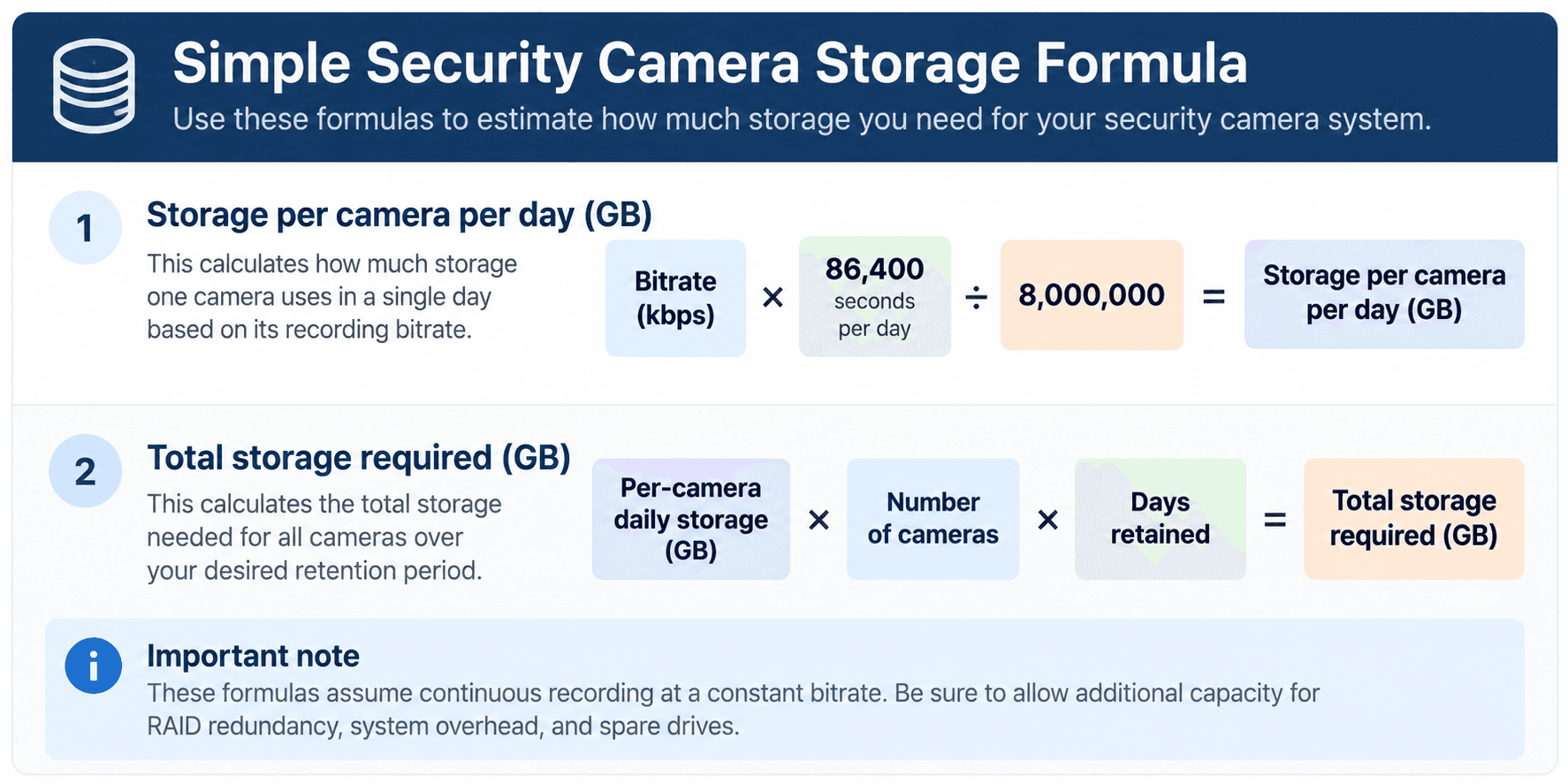
How to calculate your security camera storage
For continuous recording at a constant bitrate, use the following formulas:
A Working Example: 40 cameras recording continuously for six years
Let's say you operate a manufacturing facility with 40 security cameras recording continuously, 24 hours a day, seven days a week. You need to determine how much storage is required to retain footage for one year or potentially six years to meet regulatory or quality assurance requirements.
Assuming each camera records at an average bitrate of 512 kbps, here's how the storage requirements break down:
- One camera: Approximately 5.5 GB of footage per day.
- 40 cameras: Approximately 221 GB of footage per day.
- One year of retention: Approximately 81 TB of storage.
- Six years of retention: Approximately 484 TB of storage.
For a pharmaceutical manufacturer retaining footage for a product with a five-year expiry date plus one additional year, this could mean needing almost 500 TB of storage for just 40 cameras.
These figures are illustrative and assume a constant 512 kbps bitrate, which may be too low for some surveillance applications. They also exclude RAID redundancy, spare drives, and system overhead, meaning the actual storage capacity required would be higher.
The takeaway? The longer you need to retain footage, the more important it becomes to design your security camera storage system around your specific retention requirements. SCW can help calculate the capacity you need and develop a scalable, reliable long-term storage solution.
Why recording bitrate matters
Bitrate has a direct effect on how much storage a camera consumes.
Reducing recording resolution, frame rate, or bitrate can significantly decrease storage requirements. However, these settings must still provide sufficient image quality for the footage's intended purpose.
For example, a pharmaceutical manufacturer may need enough detail to verify specific production activities, while a loading dock camera may need to capture cargo handling and vehicle movements clearly.
Some regulations also prescribe minimum recording specifications, such as California's cannabis surveillance requirements.
Where supported, businesses may use different recording streams for live monitoring and long-term storage, provided the retained footage remains suitable for its intended use.
Once the system has been sized, recording settings should be controlled and documented. Increasing bitrate or frame rate without expanding storage can shorten the actual retention period.
For a more accurate estimate, use SCW's NVR Storage Calculator to model your camera count, recording settings, retention period, and RAID configuration.
How SCW Builds Long-Term Video Storage Systems
Standard commercial security camera systems are often designed to retain footage for weeks rather than years.
For facilities facing extended retention requirements, SCW designs dedicated video storage solutions that combine high-capacity recording hardware, expandable storage, and redundancy.
The objective is simple: keep the required footage available, protected, and accessible throughout its entire retention period.
High-capacity commercial NVRs
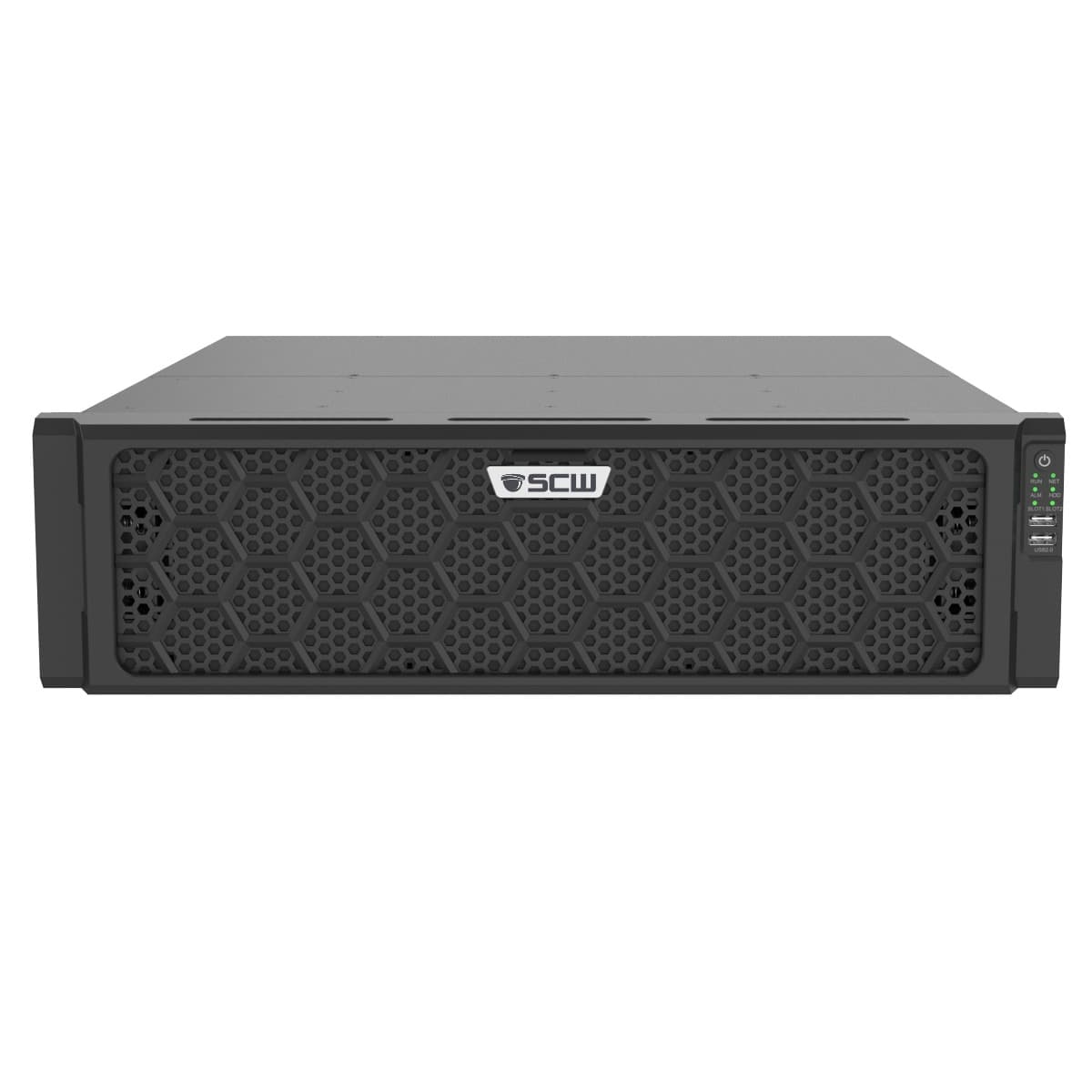
SCW's Imperial 128-channel NVR (IMP128-V3) supports up to 128 IP cameras and offers 20 hot-swappable hard drive bays, with support for drives up to 24 TB each under specified operating conditions.
The recorder also supports RAID configurations and optional redundant power supplies, making it suitable for demanding commercial environments.
Expandable storage for multi-year retention
For facilities requiring additional capacity, SCW offers 16-drive Mini-SAS expansion enclosures that extend storage beyond the recorder's internal drive bays.
Depending on the recorder and configuration, SCW can build individual systems exceeding 650 TB in total storage capacity.
This scalability is particularly valuable for pharmaceutical manufacturers, industrial facilities, and other businesses that need to retain large volumes of video for extended periods.
Surveillance-grade hard drives
Long-term recording systems require drives designed for continuous operation.
SCW offers 24 TB surveillance-grade hard drives rated for 24/7 recording workloads.
These drives help provide the capacity required for extended retention, while supporting the continuous writing demands of commercial video surveillance. Compatibility and operating temperature requirements must be checked for each recorder.
RAID protection and redundancy
For systems retaining footage over several years, drive failure is an important consideration.
SCW supports RAID configurations that protect against certain hard drive failures:
- RAID 5: Can tolerate the failure of one drive within the array without losing the stored footage.
- RAID 6: Can tolerate the failure of two drives within the array, providing additional protection for larger storage configurations.
SCW's RAID guidance recommends RAID 5 or RAID 6 as suitable options for surveillance systems requiring a balance of storage capacity and fault tolerance.
However, RAID protection consumes some of the system's raw storage capacity. Spare drives, system overhead, and future growth must also be factored into the design.
RAID is not a substitute for backup. It protects against specified drive failures but cannot eliminate risks such as accidental deletion, corruption, theft, or catastrophic system damage.
Redundant recording and backup options
For businesses where footage availability is critical, SCW can also support redundant recording and backup configurations.
These may include network-attached storage (NAS) and secondary recording destinations, depending on the equipment and network architecture.
Learn more about SCW's redundant recording and backup options.
For regulated environments, businesses should also consider how backups are verified, how quickly archived footage can be retrieved, and whether stored recordings are adequately protected against unauthorized modification or deletion.
Designed around your retention requirements
SCW doesn't approach long-term retention as a one-size-fits-all storage upgrade.
Our team works with businesses to understand their camera coverage, recording requirements, retention periods, and operational risks before recommending an appropriate system.
From selecting commercial-grade cameras and NVRs to planning storage expansion, redundancy, and installation, SCW can help develop a system that supports both day-to-day surveillance and long-term recordkeeping.
Need a system designed around your facility? Request a free security camera floorplan and speak with our team about your retention requirements.
Video Retention Guides by Industry
Different industries face different video retention challenges. While some businesses primarily need footage for security and incident investigations, others rely on recordings to support regulated production processes, quality assurance, and customer requirements.
Explore the following industry-specific guides to understand how these requirements affect your surveillance strategy.
Pharmaceutical Video Surveillance: FDA, GMP & Video Retention Considerations
Learn how FDA recordkeeping requirements and GMP expectations affect video retention in pharmaceutical manufacturing. Explore when production footage supports batch records, why expiry-based retention matters, and how to design storage systems capable of preserving footage for five or more years.
Video Surveillance for Food Manufacturing: Retention, HACCP & Investigations
Understand how security camera footage can support food safety monitoring, sanitation procedures, and quality investigations. Learn when recordings may become regulated HACCP or SSOP records and how to align video retention with USDA requirements.
Security Camera Video Retention for Warehouses & Distribution Centers
Discover how freight claim windows, cargo theft, inventory discrepancies, and supply chain security standards influence CCTV retention. Learn why warehouse loading docks may need significantly longer retention than general security cameras.
Video Surveillance for Automotive Manufacturing: Retention, Safety Records & Investigations
Explore the role of surveillance footage in automotive manufacturing investigations, production traceability, and safety-related recordkeeping. Understand when existing video may fall within NHTSA retention rules and how manufacturers can preserve relevant evidence.
Video Surveillance for Aerospace Manufacturing: Retention, Investigations & Controlled Technology
Learn how aerospace manufacturers can use video surveillance to support production investigations, quality processes, and security requirements. Explore the importance of preserving footage during investigations and protecting recordings that may contain controlled technical information.
Frequently Asked Questions About Security Camera Video Retention
For many businesses, 30 days is a practical starting point, but some facilities need 90 days, several months, or multiple years. The appropriate period depends on applicable regulations, contractual requirements, incident discovery times, and legal preservation obligations. Different cameras can have different retention periods based on the purpose of their recordings.
The storage space needed for 30 days of recorded footage depends on the number of cameras, recording resolution, bitrate, and whether your system records continuously or only when motion is detected. Higher-quality surveillance videos generally require more storage. For an accurate estimate, use SCW's NVR Storage Calculator to determine the capacity your system needs.
Protecting data security is essential, particularly when retaining footage for months or years. Businesses should use encrypted storage where appropriate, restrict access to authorized personnel, maintain audit logs, and implement secure backup procedures. Regular system updates and storage redundancy can also help protect recordings against unauthorized access, data loss, and hardware failures. For regulated industries, additional security and recordkeeping requirements may apply.
There is no single federal law requiring every U.S. business to retain CCTV footage for a specific number of days. However, industry-specific regulations and recordkeeping rules may apply. Businesses must also consider state laws, customer contracts, certifications, and legal holds when establishing their video retention policies.
The FDA does not generally require pharmaceutical manufacturers to install security cameras throughout their facilities. However, when video is used to support GMP activities, batch records, or quality reviews, applicable recordkeeping and data-integrity expectations may affect how long it must be preserved. Requirements depend on the footage's documented role.
Most SCW NVRs automatically overwrite the oldest recordings when storage reaches capacity. This allows continuous recording but permanently removes older footage. For businesses with strict retention requirements, supported SCW NVRs can instead be configured to stop recording and issue an alert when storage is full. Storage should be sized to avoid either outcome before the required retention period ends.
Yes. A tiered retention policy allows businesses to preserve important footage for longer without extending storage requirements across every camera. Supported SCW NVRs offer Quota / Allocate Space settings that assign different storage capacities to cameras, helping achieve different retention periods when correctly configured and tested.
Identify and preserve all potentially relevant footage immediately. Suspend routine overwriting for the affected recordings, create protected copies where appropriate, and document who accessed or exported the files. Consult legal counsel to determine the scope and duration of the preservation obligation. Relevant footage should remain protected until the legal hold is formally released.
Storage depends on camera count, recording bitrate, frame rate, compression, and recording schedule. Calculate daily storage per camera, then multiply by the number of cameras and days retained. Add capacity for RAID, spare drives, and system overhead. SCW's NVR storage calculator can help estimate your requirements before choosing a long-term storage system.
Need to Keep Security Footage for Months or Years?
How long you need to retain security footage will vary depending on your industry, regulatory obligations, and the purpose of your recordings. Whether you need 90 days of footage for a warehouse or six years to support pharmaceutical batch records, having a legitimate reason for keeping footage stored longer is essential.
At SCW, we help businesses build systems around their specific retention requirements. Our specialists design commercial security camera systems with the recording capacity, expandable storage, and redundancy needed to keep critical footage available when it matters most.