
A Practical Guide for Hotel Owners, Operators, and Property Managers
Schaumburg’s Hotel Security and Safety Ordinance materials make one thing clear: hotels need video systems that produce usable footage, not just cameras on the wall. (Schaumburg Video Standards).
This guide translates those expectations into practical camera, recording, and installation decisions for Schaumburg hotel properties.
What this guide covers
While this guide focuses on Schaumburg hotel properties, the same principles apply to hotels, resorts, and hospitality properties that need stronger video quality around entrances, lobbies, guest floors, parking areas, and low-light spaces.
- Schaumburg’s published hotel camera expectations
- Practical camera placement guidance
- License plate capture and recognition planning
- Cloud and on-prem recording considerations
- Low-light and overnight coverage
- RTIC-readiness considerations
- SCW’s approach to hotel camera system design and installation
What Schaumburg’s published standards say
Schaumburg’s materials focus on the areas where hotel video quality matters most. The standards call for the ability to see faces at entrance and exit locations and the front desk, high resolution for long hallways and outdoor areas, the ability to see license plates at exterior parking entrances, and low-light capabilities for exterior cameras and dark interior areas. (Schaumburg Video Standards).
They also state that cloud or on-premises recording is acceptable as long as access is possible, and that connection to the Schaumburg PD Real-Time Information Center is recommended but not required. The system must be digital and IP-based, meet a 1080p minimum, record at a 15 FPS minimum, use a common format such as MP4/H.264, and include a time/date stamp. (Schaumburg Video Standards).
Key takeaway: Schaumburg’s standard is about image usability. A compliance-ready hotel system should help identify faces, review hallway and outdoor activity, capture vehicle plate information, and retrieve footage quickly when an incident occurs.
What this means in practice
Entrances, exits, and front desk
Hotels should place cameras for face capture, not just room overview. A lobby camera mounted too high, too wide, or too far from the point of entry may show that someone entered but fail to provide useful facial detail.
At the front desk, coverage should capture both guest interaction context and usable face visibility. This matters for check-in issues, payment disputes, guest escalations, lost-property questions, and incident documentation.
Hallways and outdoor areas
Long hallways and outdoor areas require more detail than short-range interior spaces. Camera resolution, lens choice, mounting height, viewing angle, and lighting all affect whether footage remains useful at distance.
For guest floors, stairways, parking areas, outdoor walkways, and building perimeters, hotels should test real footage rather than relying only on camera specifications.
Parking entrances
Schaumburg’s standards call for the ability to see license plates at exterior parking entrances, with the Village ALPR system preferred. That usually requires a dedicated plate strategy rather than assuming a general parking lot camera will be enough. (Schaumburg Video Standards).
SCW notes that license plates are very reflective and that recording plates at night is especially difficult without a camera designed for that job. For hotels, the best plate capture points are usually controlled vehicle entry or exit areas where speed, angle, lighting, and distance can be managed. (SCW License Plate Cameras).
License plate capture vs. license plate recognition
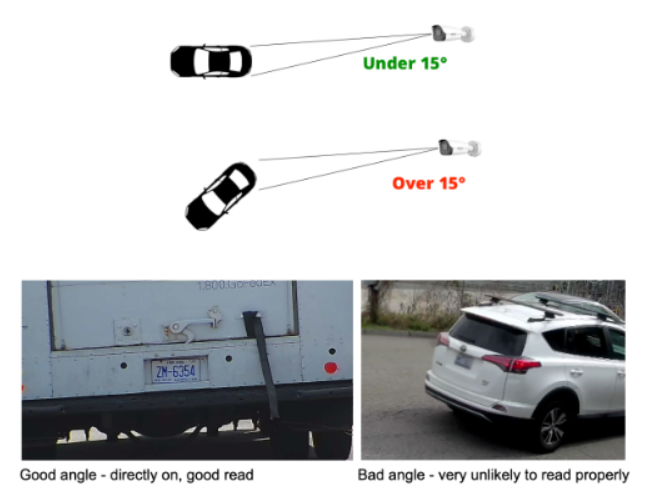
SCW license plate camera angle-of-view example | Image source: SCW
License plate capture and license plate recognition are related, but they are not the same thing. SCW explains that license plate capture cameras help record plate images, while license plate recognition cameras use analytical tools, AI, ALPR/ANPR, and OCR to recognize and process license plate information automatically. (SCW License Plate Cameras).
For a hotel, license plate capture may be enough if the goal is to see the plate in video. License plate recognition may be a better fit when the property wants plate snapshots, searchable plate numbers, lists, or more structured vehicle-entry records.
SCW insight: Plate visibility is an installation and design problem, not just a camera-spec problem.
Cloud vs. on-prem recording
Schaumburg allows cloud or on-premises recording as long as access is possible. That gives hotel operators flexibility, but it also means the system should be evaluated for retrieval, export, permissions, and operational usability. (Schaumburg Video Standards).
Low-light and overnight coverage
SCW Specialist night image example | Image source: SCW
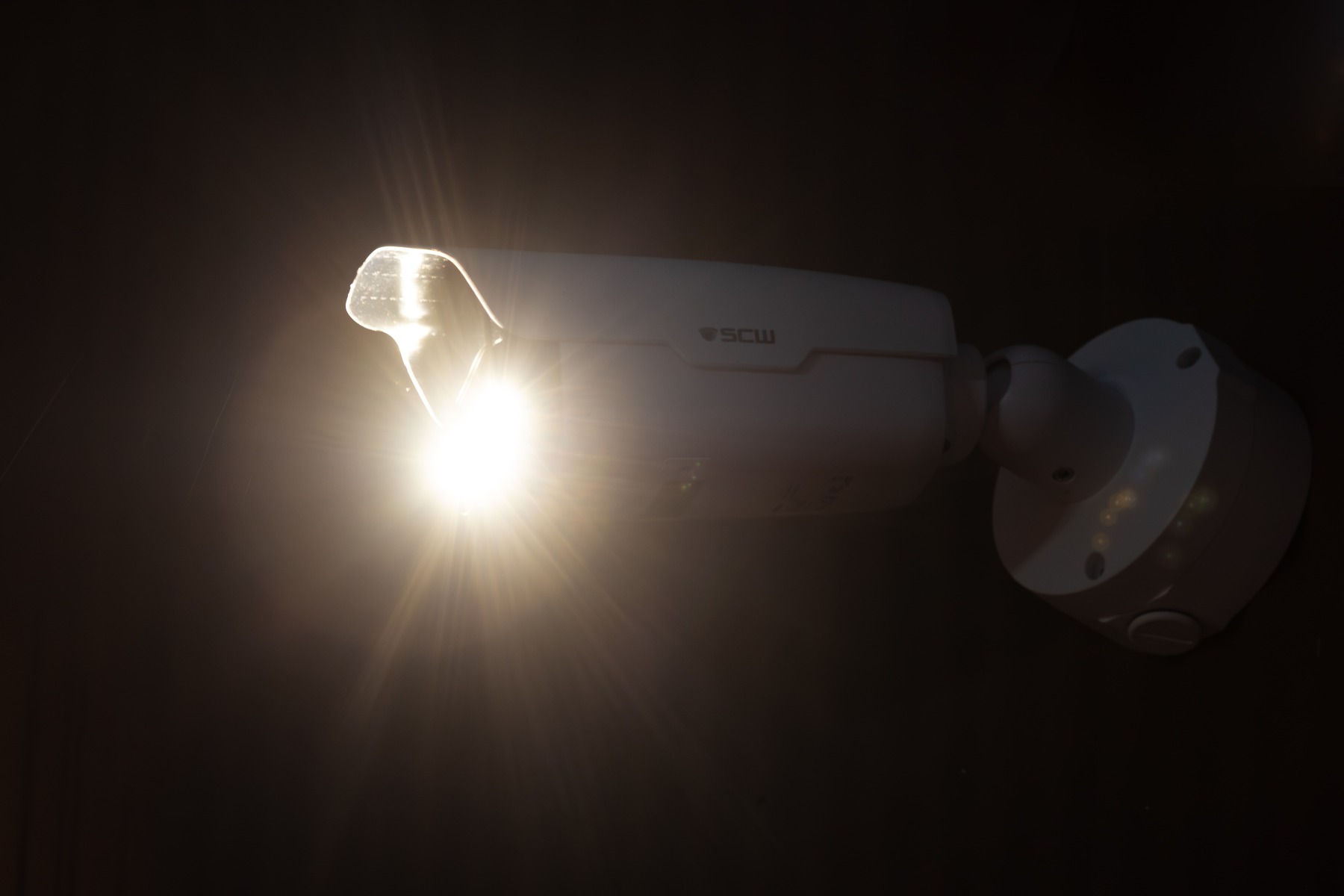
Hotels operate around the clock, so low-light performance is central to compliance readiness. Schaumburg specifically calls for low-light capabilities for exterior cameras and dark interior areas. (Schaumburg Video Standards).
Important low-light zones often include parking lots, side entrances, rear doors, stairwells, outdoor walkways, courtyards, pool areas, service corridors, and trash or loading areas.
Hotels should review footage after dark, not just during the day. The question is whether the footage remains usable when headlights, shadows, weather, reflections, and changing light levels affect the scene.
Is RTIC connection required?
Connection to the Schaumburg PD Real-Time Information Center is recommended but not required according to Schaumburg’s video standards. The same materials state that connections can be made to most video management systems but may require shared connection costs, and they specifically mention Avigilon VMS and Genetec connection paths. (Schaumburg Video Standards).
The practical recommendation is to choose a system that works now and does not create unnecessary integration barriers later. Hotels should document the VMS, recording setup, network structure, permission model, and sharing workflow before making major upgrades.
Why hotels work with SCW
SCW commercial security camera installation example | Image source: SCW
SCW’s hospitality security approach is built around layered protection for hotel environments, including parking areas, lobbies, guest room floors, outdoor spaces, pool areas, management offices, mechanical rooms, and housekeeping areas. (SCW Hospitality Security).
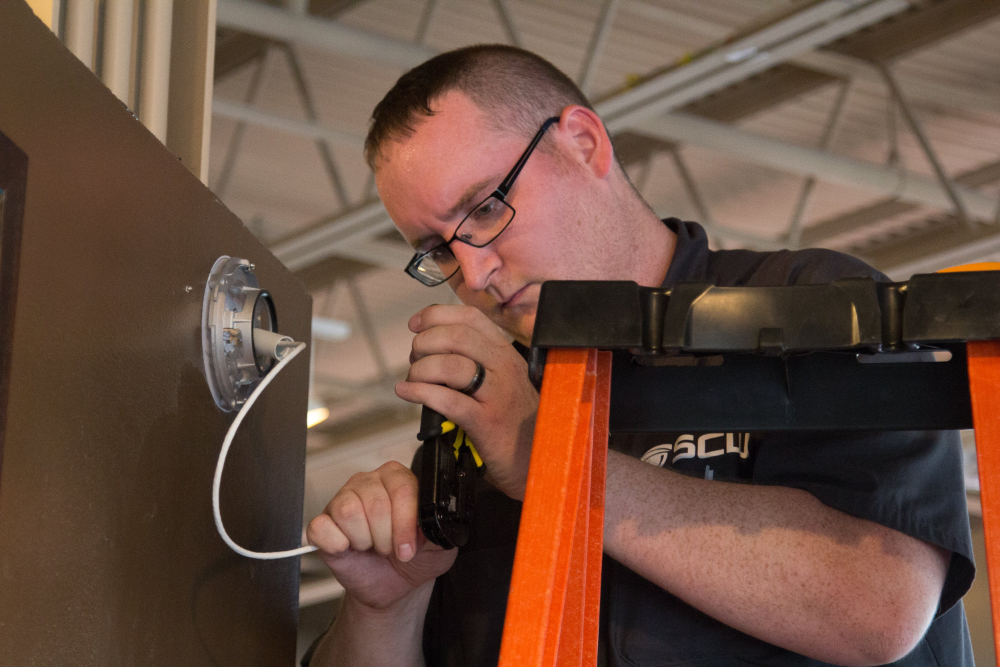
SCW’s commercial installation process includes site assessment, system design, cabling and infrastructure, configuration, and testing. SCW also states that it designs tailored solutions based on layout, risk profile, and compliance needs, from camera placement to access control zones. (SCW Commercial Security Camera Installation).
For hotel groups and larger properties, SCW combines national installation project managers with experienced local technicians and supports multi-story, multi-site, and multi-state deployments. SCW also provides lifetime U.S.-based technical support, with optional service plans and post-installation support.
Schaumburg hotel camera planning checklist
Use this checklist to evaluate whether a hotel camera system is moving toward compliance-ready performance.
Coverage
- Entrances and exits capture usable facial detail
- Front desk coverage shows faces and interaction context
- Long hallways have enough resolution and lens reach
- Outdoor areas are clear during day and night conditions
- Parking entrances have a dedicated plate visibility strategy
- Stairwells, side doors, and service areas are reviewed for low-light risk
Recording and technical setup
- System is digital and IP-based
- Cameras meet or exceed 1080p where required
- Recording meets or exceeds 15 FPS where required
- Video includes accurate time/date stamps
- Footage can be exported in MP4 or another common high-quality format
- Cloud or on-prem recording is accessible to authorized staff
Operations
- Managers know how to find and export footage
- User permissions are documented
- Retention settings are confirmed
- Low-light footage has been tested after dark
- Plate capture has been tested with real vehicle movement
- RTIC-readiness and future integration needs have been reviewed
Next steps for Schaumburg hotel owners
The best first step is a practical camera system review. Map the areas Schaumburg highlights, pull sample footage from those zones, test day and night performance, and document where the system fails to provide usable faces, plates, hallway detail, outdoor visibility, or accessible recordings. SCW can help hotels assess the current environment, design the right coverage plan, choose camera and recording options.